Why Did the Ambulance Is Used to Get Your Heart Started Again
AEDs: Loftier-Tech Help for Cardiac Arrest
You've seen it time and again on TV shows. After someone suffers sudden cardiac abort, healthcare providers grab the paddles and deliver an electrical shock to the patient to help restore a normal centre rhythm.
Engineering science has given u.s. the automatic external defibrillator (AED). This is a small, lightweight, battery operated, portable defibrillator. You may run across these devices in schools and public buildings, airports, malls, sports arenas, health clubs, golf courses, and some businesses.
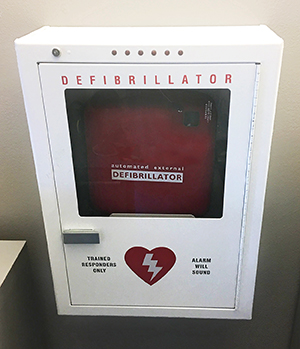
Defibrillation is needed when a centre starts to shell abnormally, and and then fast that very little blood can be pumped out to the torso. An AED uses an electric stupor to help the center render to its normal rhythm.
Hither are some FAQs to assist bring you lot up to speed.
What is an automated external defibrillator?
The automated external defibrillator (AED) is a computerized medical device. It'southward battery powered with agglutinative defibrillator pads that are applied to the chest to let an electrical current to pass through to the heart to reset the heart's normal electrical current. A normal, regular or organized electrical rhythm through the centre is necessary for the muscle to contract and pump blood to the body.
When a person is in cardiac abort, they accept either no electrical current, a rapid rhythm that doesn't allow for the heart pumping chambers to fill up properly (ventricular tachycardia), or a disorganized electrical rhythm or current that doesn't permit the heart muscle to contract and broadcast blood to the body (ventricular fibrillation). Ventricular fibrillation and ventricular tachycardia can be stopped with an electric shock to restore normal middle rhythm and circulation to the body. This is called either cardioversion or defibrillation.
An AED can check a person's heart rhythm through monitors that are in the defibrillator pads, so yous don't have to be a trained expert to recognize irregular eye rhythms to salvage someone'south life using an AED. The AED can recognize a rapid or irregular eye rhythm that requires a shock. And, information technology can advise the rescuer when a stupor is needed. The AED uses vox prompts, lights, and text messages to tell the rescuer the steps to take.
AEDs are very authentic and like shooting fish in a barrel to use. There are many different brands of AEDs, merely the same bones steps apply to all of them. The American Middle Association doesn't recommend a specific model.
Exercise you demand training to use an AED?
No. Almost anyone with or without a medical groundwork can learn to use an AED or utilise the pads properly and administrate a daze by post-obit the prompts provided past the AED. Commonly, people learn to apply an AED in a course that also teaches CPR. The computerized device will tell a rescuer to push the defibrillate button if cardiac arrest is from an abnormal heart rhythm that could reply to a shock. (Not all rhythms will.) This could be either ventricular fibrillation or ventricular tachycardia. Ventricular fibrillation is the well-nigh common eye-rhythm problem in victims of sudden cardiac arrest.
Won't the cost of devices similar AEDs keep them out of most places?
No. The cost of AEDs has decreased a lot in the past few years. Many of these devices and the replacement components cost about $1500 to $2000.
Are AEDs really needed in places other than hospitals?
The charge per unit of sudden cardiac death can be reduced past placing AEDs in the community and by teaching people how to use them. Seconds and minutes count when cardiac arrest occurs. The likelihood of survival decreases for every minute that goes past without this type of help.
Is an AED useful for all types of cardiac arrest?
No. Other abnormal rhythms like a very slow heart rate or no heartbeat at all, tin can't be treated with an AED. When a user puts the AED's electrodes or adhesive pads on a victim's chest, the device determines whether the patient'south heart needs to be shocked or not. Then the AED will instruct the rescuer nearly the next steps. Many of the newer models talk the rescuer through the steps. They automatically deliver the shock if appropriate.
Do AEDs mean CPR is no longer needed?
Admittedly non. The 2 go together to properly resuscitate someone having a cardiac abort. An AED tin can restore a normal heart rhythm in certain cases. Chest compressions in CPR are used to assistance keep blood flowing through the heart and the body. CPR can double the chances of survival when used properly when a person collapses and just before an AED delivers a shock. CPR should be started while someone else gets the AED.
Does research dorsum the community use of AEDs?
Yep. Ane report looked at the survival rates of people who had sudden cardiac arrest in casinos and got AED treatment from security personnel. There was a 75% survival charge per unit for people who got their first shock within three minutes compared to a 50% survival rate for those shocked after more 3 minutes.
Source: https://www.urmc.rochester.edu/encyclopedia/content.aspx?contenttypeid=1&contentid=2199
0 Response to "Why Did the Ambulance Is Used to Get Your Heart Started Again"
Enviar um comentário