Which of the Following Movements Were Primarily American? Art History

Visual fine art of the United States or American art is visual art fabricated in the The states or past U.S. artists. Before colonization there were many flourishing traditions of Native American art, and where the Spanish colonized Spanish Colonial architecture and the accompanying styles in other media were quickly in place. Early colonial art on the East Coast initially relied on artists from Europe, with John White (1540-c. 1593) the primeval case. In the late 18th and early 19th centuries, artists primarily painted portraits, and some landscapes in a style based mainly on English painting. Furniture-makers imitating English language styles and similar craftsmen were also established in the major cities, only in the English colonies, locally made pottery remained resolutely commonsensical until the 19th century, with fancy products imported.
Merely in the later on 18th century ii U.Southward. artists, Benjamin West and John Singleton Copley, became the most successful painters in London of history painting, and then regarded every bit the highest form of art, giving the first sign of an emerging strength in Western art. American artists who remained at domicile became increasingly skilled, although at that place was petty awareness of them in Europe. In the early 19th century the infrastructure to train artists began to be established, and from 1820 the Hudson River School began to produce Romantic landscape painting that was original and matched the huge scale of U.S. landscapes. The American Revolution produced a demand for patriotic art, especially history painting, while other artists recorded the frontier land. A parallel development taking shape in rural U.Due south. was the American craft movement, which began as a reaction to the industrial revolution.
After 1850 Academic fine art in the European style flourished, and equally richer Americans became very wealthy, the flow of European fine art, new and old, to the US began; this has continued ever since. Museums began to exist opened to display much of this. Developments in mod art in Europe came to the U.S. from exhibitions in New York City such as the Arsenal Bear witness in 1913. Later on World War Ii, New York replaced Paris every bit the center of the art world. Since then many U.South. movements take shaped Mod and Postmodern fine art. Art in the United States today covers a huge range of styles.
Ancestry [edit]

One of the first painters to visit British America was John White (c. 1540 – c. 1606), who fabricated of import watercolor records of Native American life on the Eastern seaboard (now in the British Museum). White outset visited America as the creative person and map-maker for an expedition of exploration, and in the early on years of the Colonial menstruum near other artists trained in Western styles were officers in the army and navy, whose preparation included sketching landscapes. Somewhen the English settlements grew large enough to back up professional artists, mostly portrait-painters, often largely self-taught.
Amidst the earliest was John Smybert (1688–1751), a trained artist from London who emigrated in 1728 intending to be a professor of art, but instead became a portrait painter and printseller in Boston. His friend Peter Pelham was a painter and printmaker. Both needed other sources of income and had shops. Meanwhile, the Spanish territories afterward to be American could see more often than not religious art in the late Baroque way, mostly by native artists, and Native American cultures continued to produce art in their diverse traditions.
Eighteenth century [edit]

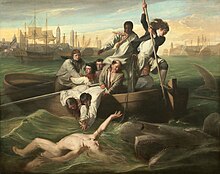
After the Declaration of Independence in 1776, which marked the official commencement of the American national identity, the new nation needed a history, and office of that history would exist expressed visually. Most of early American fine art (from the tardily 18th century through the early 19th century) consists of history painting and especially portraits. As in Colonial America, many of the painters who specialized in portraits were substantially self-taught; notable amongst them are Joseph Badger, John Brewster Jr., and William Jennys. The young nation's artists generally emulated the style of British art, which they knew through prints and the paintings of English-trained immigrants such as John Smibert (1688–1751) and John Wollaston (active 1742–1775).[two]
Robert Feke (1707–1752), an untrained painter of the colonial period, achieved a sophisticated style based on Smibert's example.[3] Charles Willson Peale, who gained much of his earliest art training past studying Smibert'due south copies of European paintings,[4] painted portraits of many of the important figures of the American Revolution. Peale's younger brother James Peale and six of Peale's nieces and sons— Anna Claypoole Peale, Sarah Miriam Peale, Raphaelle Peale, Rembrandt Peale, Rubens Peale and Titian Peale—were also artists. Painters such equally Gilbert Stuart fabricated portraits of the newly elected government officials,[i] which became iconic afterward beingness reproduced on various U.S. Postage stamps of the 19th century and early 20th century.[five]
John Singleton Copley painted allegorical portraits for the increasingly prosperous merchant class, including a portrait of Paul Revere (ca. 1768–1770). The original version of his most famous painting, Watson and the Shark (1778), is in the drove of The National Gallery of Art[vi] while there is another version in the Boston Museum of Fine Arts and a third version in the Detroit Institute of Arts. Benjamin W painted portraits as well every bit history paintings of the French and Indian War. W as well worked in London where many American artists studied under him, including Washington Allston,[7] Ralph Earl, James Earl,[eight] Samuel Morse, Charles Willson Peale, Rembrandt Peale, Gilbert Stuart, John Trumbull, Mather Brown, Edward Savage and Thomas Sully.[9] John Trumbull painted large battle scenes of the Revolutionary War. When landscape was painted it was most frequently done to show how much property a subject owned, or every bit a picturesque groundwork for a portrait.
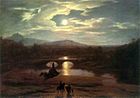
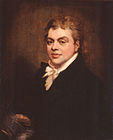
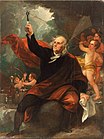
Selection of works by early American artists [edit]



Nineteenth century [edit]

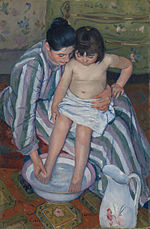
National Gallery of Art, Washington DC.
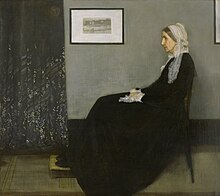
The first well-known U.S. schoolhouse of painting—the Hudson River School—appeared in 1820. Thomas Cole pioneered the move which included Albert Bierstadt, Frederic Edwin Church, Thomas Doughty and several others. As with music and literature, this development was delayed until artists perceived that the New World offered subjects unique to itself; in this case the westward expansion of settlement brought the transcendent beauty of frontier landscapes to painters' attending.
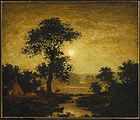
The Hudson River painters' directness and simplicity of vision influenced and inspired such afterwards artists as John Kensett and the Luminists; besides every bit George Inness and the tonalists (which included Albert Pinkham Ryder and Ralph Blakelock amongst others), and Winslow Homer (1836–1910), who depicted the rural U.Due south.—the sea, the mountains, and the people who lived most them.
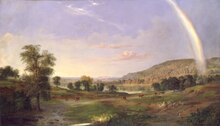
The Hudson River School landscape painter Robert Southward. Duncanson was 1 of the first important African American painters. John James Audubon, an ornithologist whose paintings documented birds, was one of the most of import naturalist artists in the early U.S. His major work, a set of colored prints entitled The Birds of America (1827–1839), is considered one of the finest ornithological works ever completed. Edward Hicks was a U.S. folk painter and distinguished minister of the Club of Friends. He became a Quaker icon because of his paintings.
Paintings of the Cracking Due west, many of which emphasized the sheer size of the land and the cultures of the native people living on it, became a singled-out genre too. George Catlin depicted the West and its people as honestly as possible. George Caleb Bingham, and subsequently Frederic Remington, Charles M. Russell, the photographer Edward S. Curtis, and others recorded the U.S. Western heritage and the Quondam American West through their fine art.
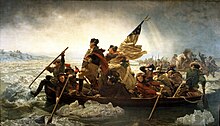
History painting was a less pop genre in U.S. art during the 19th century, although Washington Crossing the Delaware, painted by the German-born Emanuel Leutze, is among the all-time-known U.S. paintings. The historical and military paintings of William B. T. Trego were widely published after his death (co-ordinate to Edwin A. Peeples, "There is probably not an American History volume which doesn't have (a) Trego picture in it").[10]
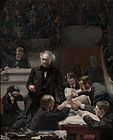
Portrait painters in the U.South. in the 19th century included untrained limners such as Ammi Phillips, and painters schooled in the European tradition, such as Thomas Sully and G.P.A. Healy. Centre-class city life found its painter in Thomas Eakins (1844–1916), an uncompromising realist whose unflinching honesty undercut the genteel preference for romantic sentimentalism. As a result, he was non notably successful in his lifetime, although he has since been recognized every bit one of the most significant U.S. artists.[11] One of his students was Henry Ossawa Tanner, the commencement African-American painter to achieve international acclaim.
A trompe-l'œil style of however-life painting, originating mainly in Philadelphia, included Raphaelle Peale (one of several artists of the Peale family unit), William Michael Harnett, and John F. Peto.
The virtually successful U.S. sculptor of his era, Hiram Powers, left the U.S. in his early on thirties to spend the residue of his life in Europe, where he adopted a conventional style for his arcadian female nudes such as Eve Tempted.[12] Several important painters who are considered American spent much of their lives in Europe, notably Mary Cassatt, James McNeill Whistler, and John Vocaliser Sargent, all of whom were influenced by French Impressionism. Theodore Robinson visited France in 1887, befriended Monet, and became i of the first U.S. painters to adopt the new technique. In the concluding decades of the century American Impressionism, every bit adept past artists such as Childe Hassam and Frank W. Benson, became a pop style.
Selection of notable 19th-century works [edit]






Twentieth century [edit]


Controversy soon became a way of life for American artists. In fact, much of American painting and sculpture since 1900 has been a serial of revolts confronting tradition. "To hell with the artistic values," announced Robert Henri (1865–1929). He was the leader of what critics chosen the Ashcan school of painting, after the grouping'southward portrayals of the squalid aspects of city life.
American realism became the new management for American visual artists at the plough of the 20th century. The Ashcan painters George Bellows, Everett Shinn, George Benjamin Luks, William Glackens, and John Sloan were among those who developed socially conscious imagery in their works. The photographer Alfred Stieglitz (1864–1946) led the Photo-Secession motility, which created pathways for photography as an emerging fine art form.
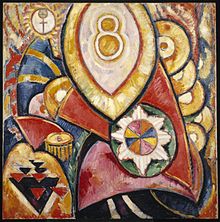
Soon the Ashcan school artists gave way to modernists arriving from Europe—the cubists and abstract painters promoted past Stieglitz at his 291 Gallery in New York Urban center. John Marin, Marsden Hartley, Alfred Henry Maurer, Arthur B. Carles, Arthur Dove, Henrietta Shore, Stuart Davis, Wilhelmina Weber, Stanton Macdonald-Wright, Morgan Russell, Patrick Henry Bruce, Andrew Dasburg, Georgia O'Keeffe, and Gerald Irish potato were some important early American modernist painters. Early on modernist sculptors in America include William Zorach, Elie Nadelman, and Paul Manship. Florine Stettheimer developed an extremely personal faux-naif mode.
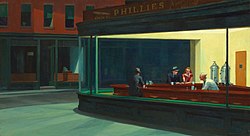
Afterward World War I many American artists rejected the modern trends emanating from the Armory Bear witness and European influences such as those from the School of Paris. Instead they chose to adopt various—in some cases academic—styles of realism in depicting American urban and rural scenes. Grant Wood, Reginald Marsh, Guy Pène du Bois, and Charles Sheeler exemplify the realist tendency in different means. Sheeler and the modernists Charles Demuth and Ralston Crawford were referred to as Precisionists for their sharply defined renderings of machines and architectural forms. Edward Hopper, who studied under Henri, developed an individual style of realism by concentrating on light and form, and avoiding overt social content.
The American Southwest [edit]
Following the first World War, the completion of the Santa Atomic number 26 Railroad enabled American settlers to travel across the w, as far as the California declension. New artists' colonies started growing up around Santa Iron and Taos, the artists' primary subject affair existence the native people and landscapes of the Southwest.
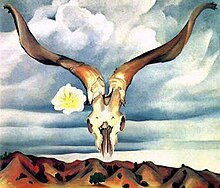
Images of the Southwest became a popular form of advertising, used virtually significantly by the Santa Fe Railroad to entice settlers to come w and bask the "unsullied landscapes." Walter Ufer, Bert Geer Phillips, Due east. Irving Couse, William Henry Jackson, Marsden Hartley, Andrew Dasburg, and Georgia O'Keeffe were some of the more prolific artists of the Southwest. Georgia O'Keeffe, who was born in the belatedly 19th century, became known for her paintings featuring flowers, basic, and landscapes of New Mexico equally seen in Ram's Head White Hollyhock and Petty Hills. O'Keeffe visited the Southwest in 1929 and moved there permanently in 1949; she lived and painted there until she died in 1986.
Harlem Renaissance (1920s-1930s) [edit]
The Harlem Renaissance was another significant development in American art. In the 1920s and 30s a new generation of educated and politically astute African-American men and women emerged who sponsored literary societies and fine art and industrial exhibitions to combat racist stereotypes. The movement, which showcased the range of talents within African-American communities, included artists from across America, but was centered in Harlem. The work of the Harlem painter and graphic artist Aaron Douglas and the photographer James VanDerZee became allegorical of the motility. Artists associated with the Harlem Renaissance include Romare Bearden, Jacob Lawrence, Charles Alston, Augusta Savage, Archibald Motley, Lois Mailou Jones, Palmer Hayden and Sargent Johnson.
New Bargain art (1930s) [edit]

When the Great Depression worsened, president Roosevelt'southward New Deal created several public arts programs. The purpose of the programs was to give work to artists and decorate public buildings, unremarkably with a national theme. The first of these projects, the Public Works of Art Project (PWAP), was created after successful lobbying past the unemployed artists of the Artists Union.[13] The PWAP lasted less than i twelvemonth, and produced nearly 15,000 works of art. Information technology was followed by the Federal Art Project of the Works Progress Assistants (FAP/WPA) in 1935, which funded some of the most well-known American artists.[14]
The style of much of the public art commissioned by the WPA was influenced by the piece of work of Diego Rivera and other artists of the contemporary Mexican muralism motion. Several separate and related movements began and developed during the Not bad Low including American scene painting, Regionalism, and Social Realism.[xv] Thomas Hart Benton, John Steuart Curry, Grant Wood, Maxine Albro, Ben Shahn, Joseph Stella, Reginald Marsh, Isaac Soyer, Raphael Soyer, Spencer Baird Nichols and Jack Levine were some of the best-known artists.
Not all of the artists who emerged in the years betwixt the wars were Regionalists or Social Realists; Milton Avery's paintings, often almost abstract, had a significant influence on several of the younger artists who would before long get known as Abstract Expressionists.[sixteen] Joseph Cornell, inspired by Surrealism, created boxed assemblages incorporating establish objects and collage.
Abstruse expressionism [edit]

Jackson Pollock, Blue Poles Number 11, 1952, enamel and aluminium pigment with drinking glass on canvas, 212.one x 488.9 cm, National Gallery of Australia. First exhibited in Pollock's studio, Blue Poles was purchased in 1973 by the Australian government for a controversial $one.iii million, condign the highest toll ever paid for a painting in the history of Australia.[17] [18]
In the years after World War II, a group of New York artists formed the outset American move to exert major influence internationally: abstract expressionism. This term, which had first been used in 1919 in Berlin, was used again in 1946 by Robert Coates in The New York Times, and was taken up by the two major art critics of that time, Harold Rosenberg and Clement Greenberg. It has always been criticized every bit as well large and paradoxical, yet the mutual definition implies the use of abstract art to express feelings, emotions, what is inside the creative person, and not what stands without.
The get-go generation of abstruse expressionists included Jackson Pollock, Willem de Kooning, Mark Rothko, Franz Kline, Arshile Gorky, Robert Motherwell, Clyfford However, Barnett Newman, Adolph Gottlieb, Phillip Guston, Advert Reinhardt, James Brooks, Richard Pousette-Dart, William Baziotes, Mark Tobey, Bradley Walker Tomlin, Theodoros Stamos, Jack Tworkov, Wilhelmina Weber Furlong, David Smith, and Hans Hofmann, amid others. Milton Avery, Lee Krasner, Louise Bourgeois, Alexander Calder, Tony Smith, Morris Graves and others were too related, important and influential artists during that period.
Though the numerous artists encompassed by this characterization had widely different styles, contemporary critics found several mutual points between them. Gorky, Pollock, de Kooning, Kline, Hofmann, Motherwell, Gottlieb, Rothko, Still, Guston, and others were an American painters associated with the abstruse expressionist move and in about cases Action painting (every bit seen in Kline'south Painting Number 2, 1954); every bit part of the New York School in the 1940s and 1950s.
Many first generation abstract expressionists were influenced both by the Cubists' works (which they knew from photographs in art reviews and past seeing the works at the 291 Gallery or the Arsenal Show), by the European Surrealists, and past Pablo Picasso, Joan Miró and Henri Matisse as well equally the Americans Milton Avery, John D. Graham, and Hans Hofmann. About of them abandoned formal composition and representation of existent objects. Often the abstract expressionists decided to try instinctual, intuitive, spontaneous arrangements of space, line, shape and color. Abstruse Expressionism can be characterized by two major elements: the large size of the canvases used (partially inspired by Mexican frescoes and the works they made for the WPA in the 1930s), and the strong and unusual use of brushstrokes and experimental paint application with a new agreement of process.
Colour Field painting [edit]
The emphasis and intensification of color and large open expanses of surface were two of the principles applied to the movement called Color Field painting. Ad Reinhardt, Adolph Gottlieb, Mark Rothko, Clyfford Still and Barnett Newman were categorized as such. Another motility was chosen Action Painting, characterized past spontaneous reaction, powerful brushstrokes, dripped and splashed paint and the potent physical movements used in the production of a painting. Jackson Pollock is an case of an Activity Painter: his creative procedure, incorporating thrown and dripped paint from a stick or poured direct from the can, revolutionized painting methods.[19]
Willem de Kooning famously said near Pollock "he broke the ice for the rest of us."[20] Ironically Pollock'southward large repetitious expanses of linear fields are characteristic of Colour Field painting every bit well, as art critic Michael Fried wrote in his essay for the catalog of Three American painters: Kenneth Noland, Jules Olitski, Frank Stella at the Fogg Art Museum in 1965. Despite the disagreements between fine art critics, Abstruse Expressionism marks a turning-signal in the history of American art: the 1940s and 1950s saw international attending shift from European (Parisian) art, to American (New York) art.[21]
Colour field painting continued every bit a movement in the 1960s, as Morris Louis, Jules Olitski, Kenneth Noland, Gene Davis, Helen Frankenthaler, and others sought to make paintings which would eliminate superfluous rhetoric with repetition, stripes and large, flat areas of color.[22]
After abstruse expressionism [edit]


During the 1950s abstract painting in America evolved into movements such as Neo-Dada, Post painterly brainchild, Op Art, hard-edge painting, Minimal fine art, Shaped sail painting, Lyrical Abstraction, and the continuation of Abstruse expressionism. As a response to the trend toward abstraction imagery emerged through various new movements like Pop Art, the Bay Expanse Figurative Motility and later in the 1970s Neo-expressionism.
Lyrical Abstraction along with the Fluxus movement and Postminimalism (a term first coined by Robert Pincus-Witten in the pages of Artforum in 1969)[24] sought to aggrandize the boundaries of abstract painting and Minimalism by focusing on process, new materials and new ways of expression. Postminimalism often incorporating industrial materials, raw materials, fabrications, found objects, installation, series repetition, and oft with references to Dada and Surrealism is best exemplified in the sculptures of Eva Hesse.[24]
Lyrical Abstraction, Conceptual Art, Postminimalism, Earth Art, Video, Performance art, Installation art, along with the continuation of Fluxus, Abstract Expressionism, Color Field Painting, Hard-edge painting, Minimal Art, Op fine art, Pop Art, Photorealism and New Realism extended the boundaries of Contemporary Art in the mid-1960s through the 1970s.[25]
Lyrical Abstraction shares similarities with Colour Field Painting and Abstract Expressionism, specially in the freewheeling usage of pigment texture and surface. Direct cartoon, calligraphic utilise of line, the effects of brushed, splattered, stained, squeegeed, poured, and splashed paint superficially resemble the effects seen in Abstract Expressionism and Color Field Painting. All the same the styles are markedly dissimilar.[26] [27]
During the 1960s, 1970s and 1980s painters as powerful and influential as Adolph Gottlieb, Phillip Guston, Lee Krasner, Cy Twombly, Robert Rauschenberg, Jasper Johns, Richard Diebenkorn, Josef Albers, Elmer Bischoff, Agnes Martin, Al Held, Sam Francis, Kenneth Noland, Jules Olitski, Ellsworth Kelly, Morris Louis, Gene Davis, Frank Stella, Joan Mitchell, Friedel Dzubas, Paul Jenkins and younger artists similar Brice Marden, Robert Mangold, Sam Gilliam, Sean Scully, Elizabeth Murray, Walter Darby Bannard, Larry Zox, Ronnie Landfield, Ronald Davis, Dan Christensen, Susan Rothenberg, Ross Bleckner, Richard Tuttle, Julian Schnabel, Peter Halley, Jean-Michel Basquiat, Eric Fischl and dozens of others produced vital and influential paintings.
Other modern American movements [edit]
Members of the adjacent artistic generation favored a unlike form of abstraction: works of mixed media. Among them were Robert Rauschenberg (1925–2008) and Jasper Johns (1930- ), who used photos, newsprint, and discarded objects in their compositions. Pop artists, such as Andy Warhol (1928–1987), Larry Rivers (1923–2002), and Roy Lichtenstein (1923–1997), reproduced, with satiric care, everyday objects and images of American popular culture—Coca-Cola bottles, soup cans, comic strips.
Realism has besides been continually pop in the United states, despite modernism's touch on; the realist tendency is evident in the metropolis scenes of Edward Hopper, the rural imagery of Andrew Wyeth, and the illustrations of Norman Rockwell. In certain places Abstruse Expressionism never caught on; for example, in Chicago, the dominant art style was grotesque, symbolic realism, as exemplified by the Chicago Imagists Cosmo Campoli (1923–1997), Jim Nutt (1938- ), Ed Paschke (1939–2004), and Nancy Spero (1926–2009).
Contemporary art into the 21st century [edit]
At the first of the 21st century, gimmicky art in the United States in full general continues in several contiguous modes, characterized past the idea of Cultural pluralism. The "crisis" in painting and current fine art and current art criticism today is brought about by pluralism. There is no consensus, nor need there be, as to a representative fashion of the age. There is an anything goes attitude that prevails; an "everything going on" syndrome; with no firm and clear direction and yet with every lane on the artistic state highway filled to chapters. Consequently, magnificent and important works of art continue to exist made in the United States albeit in a wide multifariousness of styles and aesthetic temperaments, the marketplace being left to gauge merit.
Hard-border painting, Geometric abstraction, Appropriation, Hyperrealism, Photorealism, Expressionism, Minimalism, Lyrical Abstraction, Pop art, Op art, Abstract Expressionism, Color Field painting, Monochrome painting, Neo-expressionism, Collage, Intermedia painting, Assemblage painting, Digital painting, Postmodern painting, Neo-Dada painting, Shaped canvas painting, environmental mural painting, Graffiti, traditional effigy painting, Mural painting, Portrait painting, are a few continuing and electric current directions in painting at the beginning of the 21st century.
Notable figures [edit]
A few American artists of note include: Ansel Adams, John James Audubon, Milton Avery, Jean-Michel Basquiat, Thomas Hart Benton, Albert Bierstadt, Alexander Calder, Mary Cassatt, Frederic Edwin Church building, Chuck Close, Thomas Cole, Robert Crumb, Edward S. Curtis, Richard Diebenkorn, Thomas Eakins, Jules Feiffer, Lyonel Feininger, Helen Frankenthaler, Arshile Gorky, Keith Haring, Marsden Hartley, Al Hirschfeld, Hans Hofmann, Winslow Homer, Edward Hopper, Jasper Johns, Georgia O'Keeffe, Jack Kirby, Franz Kline, Willem de Kooning, Lee Krasner, Dorothea Lange, Roy Lichtenstein, Morris Louis, John Marin, Agnes Martin, Joan Mitchell, Grandma Moses, Robert Motherwell, Nampeyo, Kenneth Noland, Jackson Pollock, Human Ray, Robert Rauschenberg, Frederic Remington, Norman Rockwell, Mark Rothko, Albert Pinkham Ryder, John Singer Sargent, Cindy Sherman, David Smith, Frank Stella, Clyfford Still, Gilbert Stuart, Louis Comfort Tiffany, Cy Twombly, Andy Warhol, Grant Wood, Frank Lloyd Wright, and Andrew Wyeth.
See besides [edit]
- Aesthetics
- Architecture of United States
- Art education in the United States
- Cinema of the The states
- History of painting
- Ledger fine art
- Modern art museums in the United states
- Museums of American art
- National Museum of the American Indian
- Native American museums in New York
- Photography in the Us
- Sculpture of the United States
- Synchromism
- Timeline of Native American art history
- Visual arts of Chicago
- Western painting
- Australian art
- Minimal art
References [edit]
- ^ a b Gilbert Stuart Birthplace and Museum. Gilbert Stuart Biography. Accessed July 24, 2007.
- ^ National Gallery of Art Archived 2009-05-12 at the Wayback Machine
- ^ Flexner, James Thomas. John Singleton Copley. Fordham University Press. 1948. p. 20. ISBN 0823215237
- ^ Booker Wright, Louis, The Arts in America: the colonial period. Schocken. 1975. p. 172.
- ^ Smithsonian National Postal Museum
- ^ "National Gallery of Art". Archived from the original on 2012-07-01. Retrieved 2012-06-thirty .
- ^ Barratt, Carrie Rebora. "Students of Benjamin West (1738–1820)". In Heilbrunn Timeline of Art History. New York: The Metropolitan Museum of Art, 2000–October 2004. Retrieved July 13, 2012.
- ^ Robert K. Stewart, James Earl: Painter of Loyalists and his career in England
- ^ "The Joseph Downs Collection". Winterthur Library. Retrieved 2008-03-24 .
- ^ "James A. Michener Art Museum: Bucks County Artists". Michenermuseum.org . Retrieved 2012-04-09 .
- ^ TFAOI.com. Philadelphia Museum of Art. Retrieved July 13, 2012
- ^ National Museum of American Art (U.S.), & Kloss, Due west. Treasures from the National Museum of American Art. Washington: National Museum of American Fine art. 1985. pp. 189–190. ISBN 0874745950
- ^ History of the New Bargain Art Projects
- ^ Eric Arnesen, ed. Encyclopedia of U.S. labor and working-course history (2007) vol. i p. 1540
- ^ MoMA, The Collection, Social Realism
- ^ Chernow, Bert. Milton Avery: a atypical vision: [exhibition], Center for the Fine Arts, Miami. Miami, Florida: Trustees of the Center for the Fine Arts Association. 1987. p. 8. OCLC 19128732
- ^ Simon Knell, National Galleries, Routledge, 2016, p. 55, ISBN 1317432428
- ^ Cosic, Miriam (August 18, 2012). "Jackson Pollock's landmark work remains in pole position". The Australian . Retrieved November one, 2012.
- ^ The Encyclopedia Americana, Volume i, Grolier Incorporated, Jan 1, 1999, p. 56, ISBN 0717201317
- ^ Carolyn Lanchner, Jasper Johns, The Museum of Modern Art, New York, N.Y., 2009, p. xx, ISBN 087070768X
- ^ Paul Cummings, American Drawings: the 20th Century, Viking Press, Academy of Michigan, 1976, ISBN 0670117846
- ^ William S. Rubin, Frank Stella, The Museum of Modern Art, Distributed by New York Graphic Gild, Greenwich, CT, 1970
- ^ Baal-Teshuva, Jacob. Marking Rothko, 1903–1970: Pictures as Drama. New York: Taschen, 2003
- ^ a b Movers and Shakers, New York, "Leaving C&M", by Sarah Douglas, Art+Sale, March 2007, Five.XXXNo7.
- ^ Martin, Ann Ray, and Howard Junker. The New Art: Information technology'south Way, Way Out, Newsweek July 29, 1968: pp.3,55-63.
- ^ Aldrich, Larry. Young Lyrical Painters, Fine art in America, 5.57, n6, November–December 1969, pp.104–113.
- ^ Thomas B. Hess on Larry Aldrich, Retrieved June 10, 2010
Sources [edit]
- American paradise: the earth of the Hudson River schoolhouse . New York: The Metropolitan Museum of Art. 1987. ISBN9780870994968.
- Avery, Kevin J. Late Eighteenth-Century American Drawings. The Metropolitan Museum Of Art. 2000-2011 The Metropolitan Museum Of Art
- Bernet, Claus; Nothnagle, Alan L.: Christliche Kunst aus den U.s., Norderstedt 2015, ISBN 978-3-7386-1339-ane.
- Mayer, Lance and Myers, Gay. American Painters on Technique: The Colonial Period to 1860. Los Angeles: Getty Publications, 2011. ISBN 978-1-60606-077-3
- Mayer, Lance and Myers, Gay. American Painters on Technique: 1860-1945. Los Angeles: Getty Publications, 2013. ISBN 978-1-60606-135-0
- Pohl, Frances Thou. Framing America. A Social History of American Fine art. New York: Thames & Hudson, 2002 (pages 74–84, 118–122, 366–365, 385, 343–344, 350–351)
- The United states. New York: The Metropolitan Museum of Art. 1987. ISBN0870994166.
External links [edit]
- American Paintings in The Metropolitan Museum of Art, a fully digitized 3 book exhibition catalog
- Inquiring Heart: American Painting, teaching resource on history of American painting
Source: https://en.wikipedia.org/wiki/Visual_art_of_the_United_States
0 Response to "Which of the Following Movements Were Primarily American? Art History"
Enviar um comentário